
 By
By 
When the registration link for the IndiaAI Impact AI Summit 2026 started circulating, most people treated it like another event announcement. Another summit. Another set of panels. Another date to maybe remember.
That reaction is understandable. We’ve trained ourselves to skim these things.
But that surface reading misses what’s actually happening here.
The IndiaAI Impact AI Summit 2026 isn’t trying to announce the future of AI in India. It’s attempting something quieter and in some ways more difficult. It’s trying to show how AI is already being absorbed into the machinery of the country, often without spectacle, sometimes without headlines.
That distinction matters.
The context this summit is emerging from
India’s AI conversation has gone through phases. First, curiosity. Then hype. Then a period of mild fatigue where everything started sounding the same. Somewhere along the way, AI became both overused and under-explained.
At the same time, real deployment kept moving.
AI began showing up in places that don’t trend on social media—governance workflows, public service delivery, language access, healthcare logistics, agricultural planning, compliance systems. Not as demos, but as tools people had to depend on.
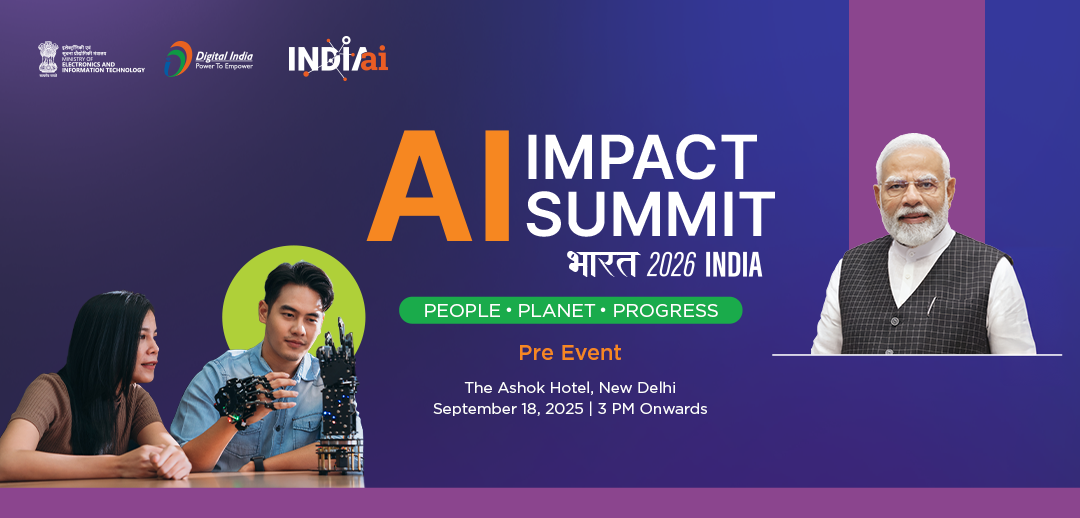
The IndiaAI Impact AI Summit comes from that shift. It’s not positioned as a showcase of possibilities. It’s positioned as a checkpoint.
What has actually worked?
What is being scaled?
What has quietly failed?
And what does “impact” even mean in the Indian context?
That last question is doing more work than it seems.
IndiaAI Impact Summit meaning, beyond the label
The word “impact” is easy to use and hard to define. In most tech events, it becomes shorthand for scale or valuation or reach.
Here, the IndiaAI Impact Summit meaning is narrower and more grounded.
Impact is framed as measurable change in systems that already exist. A reduction in processing time. Better access for non-English users. Lower friction between citizens and institutions. Fewer manual handoffs. More predictable outcomes.
None of these are glamorous. All of them matter.
This framing also forces a different kind of conversation. Instead of asking, “What can AI do next?”, the summit keeps circling back to, “What problem was actually solved?”
That’s an uncomfortable question for a lot of AI narratives. Which is probably why it’s useful.
Why 2026 feels like a deliberate moment
Timing is rarely accidental with government-linked initiatives. By 2026, India’s AI ecosystem is no longer in its early-adopter phase. Policies have moved from draft to implementation. Pilots have turned into programs. Talent pipelines are more defined.
At the same time, expectations are higher.
There’s less patience now for vague promises. Less tolerance for imported models that don’t adapt to Indian realities—language diversity, infrastructure variance, scale mismatches.

From Sam Altman to Sundar Pichai; Major AI industry leaders attending the IndiaAI summit.
The IndiaAI Impact AI Summit 2026 lands in that in-between moment. Not early enough to excuse uncertainty. Not late enough to declare victory.
It’s a moment where asking better questions matters more than announcing bold visions.
What the summit is actually trying to convene
On paper, the summit brings together policymakers, technologists, researchers, startups, and institutional stakeholders. That description could apply to dozens of events.
The difference lies in who is expected to listen, not just speak.
Many of the sessions are structured around implementation stories rather than thought leadership. Less “what we believe” and more “what happened when this went live.”
That subtle shift changes the room.
It privileges practitioners over commentators. It values friction as much as success. And it quietly encourages honesty, because the audience often includes people who’ve dealt with the same constraints.
There’s also an implicit acknowledgement here: AI in India cannot be evaluated purely through a global lens. Context is not a footnote. It’s the main variable.
The registration itself is part of the signal
The IndiaAI Summit media registration process is already open, but it’s not positioned like a mass-attendance tech conference. It’s targeted. Intentional. Almost understated.
That design choice reflects the nature of the summit itself. This isn’t about filling halls. It’s about assembling a working group large enough to represent diversity, but small enough to remain grounded.
If you’re registering expecting spectacle, you might be disappointed.
If you’re registering to understand how AI decisions are being made—and what trade-offs are involved—you’re probably in the right place.
What’s not being promised, intentionally
One thing the summit does not do is promise definitive answers. There’s no grand narrative about India “leading” or “dominating” AI. No artificial urgency. No inflated claims.
That restraint is notable.
Instead, the conversations tend to orbit around governance frameworks, public-private collaboration, responsible deployment, and long-term capability building. These are slower topics. They don’t compress well into soundbites.
But they’re also the topics that determine whether AI becomes infrastructure or remains a layer of tools.
The IndiaAI Impact AI Summit seems to understand that distinction.
Why this matters beyond the event
It’s tempting to judge summits by their immediate outcomes—announcements, MoUs, headlines. This one may not deliver many of those.
Its real value might show up later, in alignment.
When multiple stakeholders start using similar language to describe impact. When expectations between policymakers and builders become clearer. When future AI programs are designed with fewer assumptions and more memory.
Those effects are hard to measure. They don’t trend. But they compound.
In that sense, the IndiaAI Impact Summit functions less like a launchpad and more like a calibration exercise.
And honestly, calibration is overdue.
A quieter kind of signal
There’s something almost unfashionable about the way this summit positions itself. No dramatic claims. No oversized metaphors. Just a steady insistence on relevance and responsibility.
That won’t appeal to everyone.
But for those paying attention to how AI actually enters systems—slowly, unevenly, with constraints—the IndiaAI Impact AI Summit 2026 feels less like an event and more like a marker.
Not of where India wants to go.
But of where it already is, and what it’s willing to examine honestly.
Sometimes, that’s the more interesting conversation.







Comments